

4G Core Network Platform: Unveiling Its Architecture and Evolution for Modern Connectivity
2026-05-29
As 4G networks continue to power billions of connections worldwide, understanding the core network platform—the hidden engine behind seamless connectivity—has never been more crucial. From its robust architecture to its ongoing evolution toward greater efficiency and flexibility, the 4G core remains a cornerstone of modern communication. In this post, we’ll explore its design and transformative journey, with insights from IPLOOK, a leader in mobile core network solutions. Let’s demystify the technology that keeps you connected.
The Backbone of Mobile Broadband: Dissecting the 4G Core
At the heart of every seamless video call or lightning-fast download lies an intricate web of network functions collectively known as the Evolved Packet Core. More than just a traffic cop, the 4G core is built on a flat, all-IP architecture that ditched legacy circuit-switched pathways in favor of pure packet handling. This shift wasn’t just a technical upgrade—it was a philosophical one, enabling networks to treat everything from voice to streaming media as data packets, drastically simplifying how operators scale and manage their infrastructure.
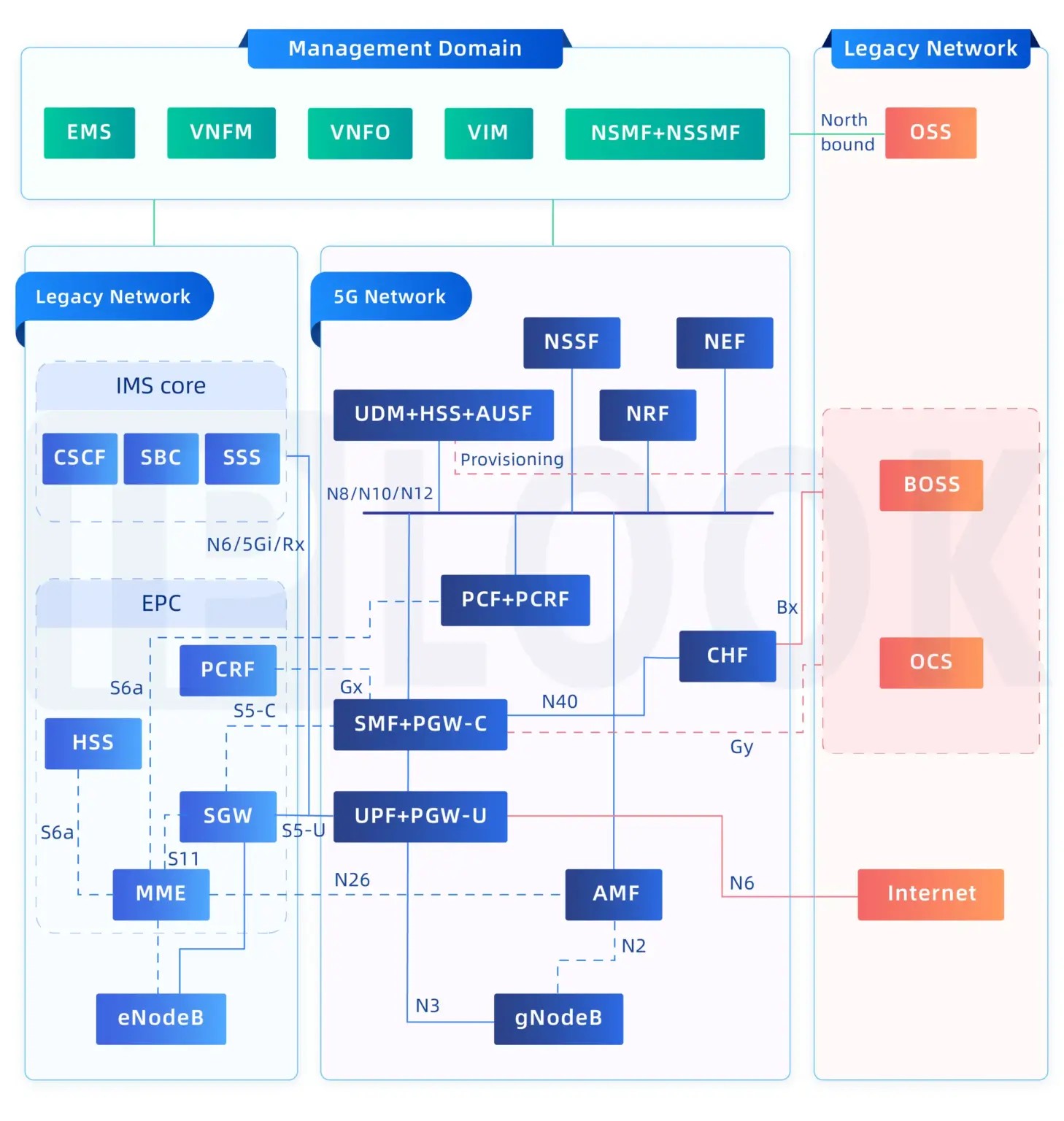
Peel back the layers and you’ll find a handful of critical components working in concert. The Mobility Management Entity acts like the brain, tracking user location and handling signaling, while the Serving Gateway and Packet Data Network Gateway form a dynamic duo that routes payloads to and from the outside world. Meanwhile, the Home Subscriber Server stores subscriber profiles, and the Policy and Charging Rules Function ensures fair usage and quality of service. Together, they create a system where handovers between towers happen in milliseconds and bandwidth can be prioritized for a business conference call over a social media scroll.
What truly sets the 4G core apart is its ecosystem-friendly design. Unlike its predecessors, it was conceived from the start to interface with non-3GPP access technologies—think trusted Wi-Fi offloading or early integration of small cells. This openness meant carriers could densify coverage without ripping out their existing backbone. Even as 5G steals the spotlight, the 4G core remains the unsung workhorse, backstopping voice calls via VoLTE and anchoring dual-connectivity setups that let new radio and old infrastructure coexist in a graceful, cost-effective dance.
From Circuit to Packet: Tracing the Evolutionary Leap
Early communication networks operated on a straightforward principle: when you placed a call, a continuous, dedicated electrical path was carved through a web of switches from your handset to the recipient’s. This circuit-switched approach worked beautifully for voice, where a steady stream of sound needed real-time delivery. But it had a glaring inefficiency—those idle pauses in conversation, sometimes half the call’s duration, held valuable network resources hostage. The connection was all-or-nothing; if a switch failed along the route, the entire channel collapsed, forcing a redial and a fresh circuit hunt.
The leap to packet switching introduced a drastically different mental model. Instead of hogging an end-to-end line, messages were chopped into discrete bundles of data, each tagged with an address and tossed into the network independently. Routers read those labels and forwarded the packets hop by hop, often scattering them across multiple, unpredictable paths. At the far end, the fragments were reassembled—sometimes out of order—like puzzle pieces. This design, born partly from Cold War survivability concerns, turned erstwhile fatal link breaks into minor detours; traffic simply flowed around damaged nodes without the conversation dropping.
That resilience tilted the scale irreversibly away from circuits. Packet switching enabled a dynamic, shared medium where thousands of users could interleave their data on the same long-haul lines, paying only for what they actually sent. It turned networks from fragile, exclusive pipelines into robust meshes that auto-heal and squish bandwidth. The evolutionary leap wasn’t just a technical upgrade—it rewired the economics and culture of connectivity, making the sprawling, always-on internet possible by default, not by design retrofit.
Key Components Fueling Seamless Connectivity
At the heart of dependable, always-on connections lies a sophisticated mesh of low-latency protocols that act as the silent choreographers of data flow. Rather than relying on bulky, one-size-fits-all routing, modern networks lean on adaptive packet scheduling and micro-segmentation. These methods let traffic slip through digital pathways almost instinctively, dodging congestion before it can snarl communication. It’s a quiet orchestration that makes streaming, voice calls, and real-time collaboration feel effortless, even when countless devices are sharing the same backbone.
Equally vital is the rise of distributed infrastructure that pushes processing power to the periphery, closer to where data is born. Instead of shuttling every request to faraway data centers, small-scale nodes handle the heavy lifting right at the source—inside factories, vehicles, or smart meters. This trimming of distance not only slashes roundtrip delays but also takes the strain off core networks. The result is a rhythm of interaction that feels immediate, as though the network is anticipating your next move rather than merely reacting.
Wrapping these technical threads together is an often-overlooked layer: intelligent spectrum management. By sensing which frequencies are underused and instantly reallocating them, systems sidestep the rigid channel assignments of the past. This dynamic shuffling means that a video conference won’t stutter just because a neighbor’s smart appliance decided to check in. It’s a delicate balancing act, continuously adjusting the invisible scaffolding that holds our wireless world upright.
Virtualization and the Software-Driven Core
Virtualization technology has fundamentally reshaped how network cores are built and operated, moving away from rigid, hardware-centric architectures. By abstracting physical resources into flexible, software-defined pools, operators can deploy and scale core functions on generic servers. This decoupling of software from proprietary appliances brings unprecedented agility, allowing rapid introduction of new services and easier capacity management without the need for specialized equipment.
A software-driven core leverages cloud-native principles such as microservices and containerization, enabling continuous integration and delivery of network functions. Rather than monolithic upgrades, components can be updated independently, reducing downtime and operational risk. This approach also supports multi-vendor environments, where best-of-breed solutions can be integrated seamlessly, fostering innovation and avoiding vendor lock-in.
Moving to a software-driven model empowers operators with automation and orchestration capabilities that were previously unattainable. Lifecycle management, from instantiation to scaling and healing, becomes fully programmable, aligning network behavior with dynamic demand. The result is a resilient, cost-effective core that can meet the evolving requirements of 5G and beyond, all while maintaining the high reliability and performance expected from critical infrastructure.
Ensuring Resilience: Redundancy and Failover Mechanisms
True resilience in any system isn't just about having spare parts lying around—it's about designing with the assumption that failure is inevitable. Redundancy means placing critical components in parallel so that no single point of collapse can bring the entire operation to a halt. But stacking up identical hardware or duplicating data without a clear failover strategy often creates a false sense of security. The real art lies in knowing which layers need immediate hot standby and which can tolerate a few minutes of automated recovery without user impact.
Effective failover mechanisms operate quietly in the background, ready to swap traffic or responsibilities without human intervention—yet they demand constant validation. Simulating failures in live environments, often called chaos engineering, uncovers brittle dependencies that documentation never mentions. When a primary database cluster loses connectivity, the secondary instance should not only take over seamlessly but also trigger diagnostic snapshots that help pinpoint root causes later. This kind of self-healing choreography keeps uptime high while giving engineers the breathing room to fix issues during business hours instead of scrambling at 2 a.m.
Beyond the technical wiring, resilience depends on how teams react when failover events cascade. Running regular game days where all monitoring is turned off forces everyone to feel the actual pain of degraded performance, sparking improvements that no planning meeting ever will. Documenting short recovery playbooks—not thick runbooks—ensures that even new team members can steer the ship when the usual captains are asleep. In the end, redundancy is only as strong as the organizational muscle memory built around it.
Bridging Generations: The 4G Core’s Role in a 5G World
As operators roll out 5G radios, the 4G Evolved Packet Core remains the silent workhorse. It anchors non-standalone architectures, handling authentication, mobility, and session management while new radio sites deliver the speed boost. This pragmatic coexistence lets carriers launch 5G quickly without a full core rip-and-replace, buying time to mature the cloud-native 5G core.
Beneath the surface, the interplay runs deep. 4G core elements like the HSS and PCRF have evolved into their 5G counterparts through careful upgrades, ensuring a unified subscriber experience across both networks. Traffic steering, security policies, and seamless handovers all lean on this hybrid foundation—proof that legacy infrastructure isn’t just tolerated in the 5G era, it’s essential.
This bridging act also tempers the industry’s rush to virtualize everything. By keeping trusted 4G core functions in place, operators avoid early pitfalls of standalone 5G, balancing cutting-edge innovation with carrier-grade reliability. The result? A transitional network that feels like a single, coherent system to devices and subscribers, even though two generations are working in concert.
FAQ
The 4G core network, technically termed the Evolved Packet Core (EPC), marks a departure from the circuit‑switched roots of earlier generations. It operates entirely on packet‑switching, treating voice and data as IP packets, which dramatically improves spectral efficiency, reduces latency, and supports the always‑on connectivity that modern apps and services expect.
The EPC consists of a few key nodes: the Mobility Management Entity (MME) handles signaling and session control, the Serving Gateway (SGW) routes user‑plane packets and acts as a mobility anchor, the Packet Data Network Gateway (PGW) connects the mobile network to external data networks, and the Home Subscriber Server (HSS) stores subscriber profiles. These elements work together through defined interfaces to authenticate users, establish bearers, and maintain session continuity as users move.
Separating control and user planes lets operators scale and manage signaling and data traffic independently. The control plane handles tasks like authentication and mobility via the MME, while the user plane forwards data through SGW and PGW. This decoupling also laid the groundwork for network function virtualization and the smoother transition to 5G’s service‑based architecture.
The EPC supports multiple connectivity classes through QoS‑based bearers and dedicated EPS bearers. For broadband, it provides high‑throughput, low‑latency links; for IoT, it offers power‑saving features and connectivity for massive numbers of devices via optimizations like CIoT in later 3GPP releases. This flexibility allows a single core to serve both smartphones and sensor networks efficiently.
The transition involved replacing circuit‑switched domains with a flat all‑IP infrastructure, eliminating the RNC in the access network, and consolidating control functions. VoLTE moved voice into the IMS overlay. The design also introduced a simplified network architecture with fewer node types, reducing latency and operational complexity while enabling higher peak data rates.
The MME is the brain of the EPC’s control plane. It handles attach procedures, bearer establishment, authentication with the HSS, and tracking area updates. It also manages the selection of SGW and PGW and paging procedures when a device is idle. Notably, the MME does not process user‑data packets itself—it only deals with signaling.
The SGW serves as a local mobility anchor for inter‑eNodeB handovers within the same geographical area and forwards user data to the PGW. The PGW acts as the gateway to external networks like the internet or corporate VPNs, allocating IP addresses, enforcing policy rules, and performing deep packet inspection. In practice, they can be collapsed into a single box for smaller deployments, but logically they serve separate roles.
The PGW is the interface point toward packet data networks, using standard IP routing. It assigns subscriber IP addresses and can tunnel traffic to enterprise networks via GRE or other protocols. Policy and charging are enforced through the PCRF, ensuring consistent quality even when roaming. This design makes the mobile network appear as just another IP access domain, enabling transparent service continuity.
Conclusion
The shift from rigid circuit-switched architectures to a packet-based framework redefined mobile networks, placing the 4G Evolved Packet Core at the center of modern broadband. Far more than a mere upgrade, it dismantled legacy hierarchies and introduced a flat, IP-centric design where the Mobility Management Entity, Serving Gateway, and Packet Data Network Gateway orchestrate everything from device attachment to data routing. These components work in concert with the Home Subscriber Server—a centralized identity vault—and the Policy and Charging Rules Function, which dynamically enforces quality of service. The MME handles authentication and bearer setup, while the gateways assign IP addresses and manage mobility; together they abstract a complex mesh into a single, reliable pipe. Unlike 3G systems, this cohesive structure slashes latency and streamlines signaling, allowing millions of simultaneous connections without congestion. This architectural overhaul directly fuels the always-on experience users now expect.
As operators confronted surging traffic, virtualization reshaped the 4G core's future, divorcing software from proprietary hardware through Network Functions Virtualization. This software-driven approach enables agile scaling and paves the way toward a cloud-native mindset. Resilience isn't an afterthought either: geographically diverse redundancy, S1-flex configurations, and automated failover mechanisms keep services alive even under multiple failures. Today, the 4G core acts as a steadfast anchor in heterogeneous networks, interworking with 5G New Radio in Non-Standalone modes. It ensures nationwide coverage continuity while 5G matures, proving that the 4G platform isn't a stepping stone—it's an enduring foundation for the interconnected era. Its design philosophy—merging flexibility with resilience—sets the blueprint for generations to come.
Contact Us
Contact Person: Shimmy
Email: [email protected]
Tel/WhatsApp: 85253392231
Website: https://www.iplook.com