

Best PP Hollow Grid Board Production Line for Efficient Manufacturing
2026-11-02
Most PP hollow grid board lines claim efficiency. Few deliver it when the material changes, the temperature shifts, or the order volume spikes. COMRISE takes a different route—engineering every module around one goal: zero slowdowns, zero surprises. In this post, we break down why that difference matters for your bottom line.
Why Multi-Layer Co-Extrusion Changes the Game for Hollow Grid Boards
Multi-layer co-extrusion doesn't just add material; it fuses engineered resins with distinct jobs into one seamless sheet during a single pass. For hollow grid boards, this removes the old trade-off between rigidity, impact resistance, and surface toughness. The core can be formulated for stiffness and load-bearing, while the outer layers handle UV exposure, scratches, and chemical contact—without any adhesives or secondary laminating steps.
What really sets the process apart is the way layers bond at the molecular level. Co-extrusion forces the molten streams together before they cool, creating a structural interlock that holds up under repeated thermal cycling, moisture, and heavy handling. Edges stay sealed, so water and debris can't work their way into the hollow channels. That translates into flatter boards, fewer warping complaints, and a longer service life in outdoor racking, reusable crates, and clean-room dividers.
There's also a material-cost angle that single-layer extrusion can't touch. A lower-cost or recycled core can be sandwiched between thin, high-performance skins, cutting weight and raw material spend without sacrificing visual quality or toughness. Additives like colorants, antistatic agents, or flame retardants can be isolated in the outer layers where they actually matter, reducing total additive load. The result is a hollow grid board that behaves more like a solid engineered panel—lighter, flatter, and far more resistant to the daily abuse that kills ordinary sheets.
Matching Screw Design to PP Melt Flow for Faster Throughput
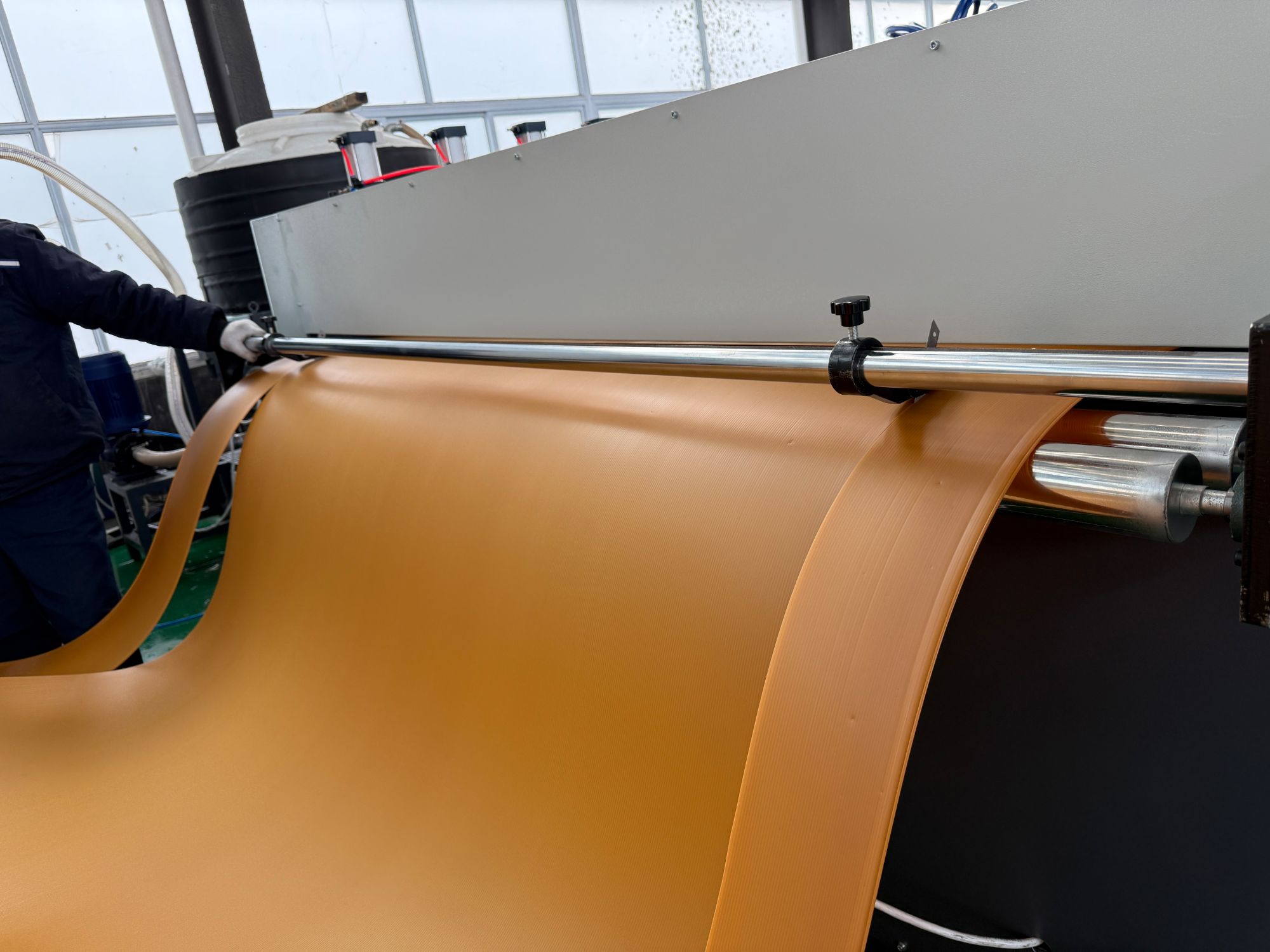
Polypropylene grades vary widely in melt flow rate, and a screw that works brilliantly for a 3 MFR homopolymer will leave money on the table with a 35 MFR random copolymer. The real problem isn't just channel depth or compression ratio in isolation—it's how the screw's shear history aligns with the viscosity curve of the specific PP. Low-MFR resins need more aggressive melting and longer residence time, but pushing them through a high-shear, shallow-channel screw built for easy-flow grades creates excessive barrel temperature, risking polymer degradation and black specks.
A better starting point is to match the feed section length and barrier clearance to the melt flow target. For high-MFR PP, a shorter feed zone with a deeper channel reduces torque spikes and lets the already-slippery melt move without excessive work. For low-MFR PP, lengthen the compression section and use a barrier flight with tighter clearances to force melting before the metering zone. This direct pairing of screw geometry to melt flow allows screw speed to rise without over-shearing, which is what actually moves throughput past the usual plateau.
Precision Temperature Zones That Prevent Warping and Waste
Most warping starts long before the final layer cools. A part that sits on a single-temperature bed still loses heat unevenly—corners shed warmth faster than the middle, and that uneven contraction pulls the edges off the plate. Precision temperature zones split the build surface into independently managed sections, each with its own heating or cooling target. This keeps the entire footprint of the part within a tighter thermal window while it prints, not just after it finishes.
The real trick is treating the bed as a set of microclimates rather than one flat heater. A central zone might run a few degrees cooler because the nozzle and surrounding plastic already hold heat there. The outer zones, which fight constant heat loss to ambient air, get extra energy to stay close to the material's ideal crystallization or glass-transition range. On some machines, a thermal camera watches the part in real time and nudges zone temperatures up or down as the geometry changes—tall thin sections get different treatment than wide flat bases.
The payoff shows up in two places: fewer lifted corners and a lot less scrap. When the temperature stays balanced across the part, internal stress doesn't have a chance to build into a visible warp. Large flat items like lids or panels stay flat without adding brims or rafts, and the printer doesn't waste power heating areas of the bed that aren't under the part. It's a quieter, smarter way to keep plastic where it belongs.
Automated Thickness Gauging: The Hidden Key to Uniform Panels
Panel consistency rarely gets the attention it deserves until a batch comes off the line with visible waves or weak spots. The old way—spot-checking a few samples with calipers—leaves too much to chance. Automated thickness gauging changes that by scanning every inch of every panel in real time, catching drift before it becomes a defect. It’s not just about catching mistakes; it’s about knowing the process is stable enough that you can trust the next panel will match the last one.
What makes automated gauging truly valuable is how quietly it works. Sensors embedded along the production path measure thickness continuously, feeding data back to the control system. If a roller wears down or material feed shifts, the system adjusts speed or pressure without an operator touching a dial. That kind of closed-loop response keeps thickness variation within a fraction of a millimeter, which matters when panels are later laminated, routed, or assembled. A uniform panel doesn’t just look better—it machines predictably and holds fasteners the way it should.
For shops still relying on manual checks, the switch can feel like overkill. But once you see the reduction in rework and customer complaints, it becomes hard to justify going back. Automated thickness gauging doesn’t make panels perfect by magic; it gives you the information to keep them uniform without slowing down the line. And in panel production, consistency is the quiet advantage that separates a trusted supplier from a gamble.
Quick-Change Screen Changers for Non-Stop Production Runs
When a screen packs up on a standard extrusion line, the usual fix is to stop the screw, let the head cool, and swap filters by hand. Quick-change screen changers sidestep that entire shutdown. A sliding plate or rotary carousel holds two or more screen cavities, so the operator can move a clean screen into the melt stream while the dirty one slides out to a vented chamber. The melt never stops flowing, and the pressure drop across the screen stays within a narrow band because the switch happens in under a second on most hydraulic or manual units.
What sets the better designs apart is how they handle the moment of crossover. The incoming screen cavity is pre-filled and sealed before it enters the melt channel, so there's no air pocket or surge when the old screen leaves. Some machines let you swap screens without touching the screw speed, which matters a lot when you're holding tight tolerances on sheet, film, or profile. Operators tend to appreciate the ones with a simple lever or foot pedal instead of a full hydraulic power pack.
In practice, that means a line running contaminated regrind or heavily filled polymer can keep producing while the operator changes screens every twenty minutes if needed. The payoff shows up as less scrap, fewer pressure spikes, and no time lost to heat-up and restart cycles. For plants that run around the clock, it's not just a convenience; it's often the difference between hitting a weekly output target and falling short because a screen clogged at 3 a.m.
Energy Recovery Systems That Cut Operating Costs Quietly
Most facility managers know the feeling of opening a monthly utility bill and wondering where the money went. Energy recovery systems work behind that number, pulling heat from exhaust air that would otherwise escape through the roof. Instead of letting a paint booth or commercial kitchen dump warm, conditioned air outside, these units transfer that thermal energy to incoming fresh air. The result is a heating or cooling load that shrinks without anyone noticing a change in comfort.
The quiet operation is not just a figure of speech. Unlike older heat-recovery setups that relied on noisy fans and high-velocity duct runs, current designs favor low-pressure drops, slower wheel rotation on enthalpy exchangers, and direct-drive motors that barely register above background hum. That makes them a better fit for spaces where noise is a genuine concern—hospitals, classrooms, office wings—without the need for extra acoustic insulation.
Payback tends to arrive faster than expected because the savings come from several directions at once: lower peak demand, fewer hours on compressors and boilers, and in some cases smaller replacement equipment when the time comes. Maintenance stays simple since fewer cycles mean less wear on primary HVAC components. For buildings with existing ductwork, many units retrofit with little disruption, which keeps the upgrade itself as unobtrusive as the ongoing operation.
FAQ
Depending on screw design and board thickness, these lines usually run between 300 and 800 kilograms per hour. The wide range comes from how much cooling capacity is integrated and whether the downstream cutter is built for continuous or indexed cutting.
The die controls polymer distribution across the board width. If the manifold is not balanced, you get weak spots near the edges and warping later. A well-designed die with adjustable restrictor bars lets operators fine-tune thickness without stopping the line.
Automatic edge trimming, online thickness gauging, and a stacker that aligns sheets without manual adjustment are the biggest labor savers. Some lines also include recipe-based control so changing board width or thickness takes minutes instead of a full shift.
Yes. Vacuum calibration combined with multiple cooling rollers works better than simple water baths because it holds the board shape while the polymer crystallizes. This prevents oil-canning and reduces the need for post-production flattening.
It can, provided the extruder has a vented barrel and a screen changer sized for at least 15 percent contamination. Without those, degraded particles from recycled material tend to build up behind the breaker plate and cause pressure fluctuations that show up as thickness variation.
Replacing the screen pack on schedule, checking screw and barrel wear every six months, and cleaning the calibration tooling are critical. Overlooking screw wear is common and leads to surging, which is hard to diagnose if you only watch the motor load.
Packaging for automotive parts, reusable logistics trays, and greenhouse panels need tight thickness tolerance. Any variation beyond about plus or minus 0.2 mm causes fit problems in automated assembly or uneven light transmission.
Look at specific energy use per kilogram of board, not just installed motor power. A line with smaller motors but poor barrel insulation may consume more energy overall. Ask for data from a one-hour continuous run at full speed, including heating, cooling, and compressed air.
Conclusion
Multi-layer co-extrusion has fundamentally reshaped how hollow grid boards are manufactured, moving beyond simple single-layer extrusion to a process that builds panels with tailored internal structures. Pairing this with screw designs specifically matched to the melt flow characteristics of PP means material moves through the barrel with minimal resistance, pushing throughput higher without sacrificing melt quality. Precision temperature zones along the barrel and die play an equally quiet but critical role—they keep the sheet from warping as it cools and cut down on edge trim waste that would otherwise eat into margins. These three elements don't act in isolation; they work together so that even at faster line speeds, the board coming off the line holds its flatness and dimensional stability.
Automated thickness gauging acts as the hidden backbone of uniform panel production, constantly feeding adjustments back to the die bolts so operators aren't left guessing between manual checks. Quick-change screen changers remove the usual downtime headache, letting the line keep running while filters are swapped out, which matters more than most realize during long production campaigns. Then there's the energy recovery side—capturing waste heat from the cooling and extrusion process and reusing it for preheating raw material or facility needs quietly lowers operating costs without any obvious change on the factory floor. Taken together, this production line isn't just a collection of upgraded parts; it's a system where each improvement compounds the next, delivering consistent output, less scrap, and lower energy bills for manufacturers who need to stay competitive without constant babysitting.
Contact Us
Contact Person: LISA LEE
Email: [email protected]
Tel/WhatsApp: +86 13780696467
Website: https://www.qdpipemachine.com