

China Wire Flattening and Shaping Lines Improve Precision in Metal Forming
2026-11-02
Metal forming tolerances are getting tighter, and China's wire flattening and shaping lines are leading the charge. No longer just about basic sizing, these advanced systems now deliver precision that directly impacts product quality and downstream efficiency. One name driving this shift is GRM—a brand that has become synonymous with reliable, high-accuracy flattening technology. Curious how these lines are reshaping the industry? Read on.
Tolerance Stack-Up Begins at the Flattening Stage
When sheet metal arrives from the mill, it carries a legacy of internal stresses and uneven thickness that no downstream operation can fully erase. The flattening stage, often treated as a mere preliminary step, quietly sets the baseline for every dimensional relationship that follows. Any variation introduced here—whether from roll pressure, feed speed, or material springback—does not stay isolated. It propagates into bending, punching, and assembly, accumulating with each contact point until the final part drifts beyond acceptable limits.
Consider a panel that is flattened only to within 0.15 mm of true flatness. Later operations reference this surface as a datum, so that initial deviation becomes a constant offset carried through every fixture and measurement. When combined with hole-position tolerances from punching and angular errors from forming, the total stack-up can easily exceed the design envelope. Operators who overlook flattening as a significant contributor often find themselves chasing phantom variation later, unaware that the root cause was established in the first few seconds of processing.
A more robust approach treats flattening as a process with its own capability study and control limits. By monitoring flatness immediately after the stage and feeding that data back into roll gap adjustments, manufacturers can tighten the distribution before subsequent operations magnify it. This shifts the conversation from containing variation downstream to eliminating it at the source, where corrections are least expensive and most effective for overall part quality.
Closed-Loop Roll Adjustment Is Quietly Becoming Standard on New Chinese Lines
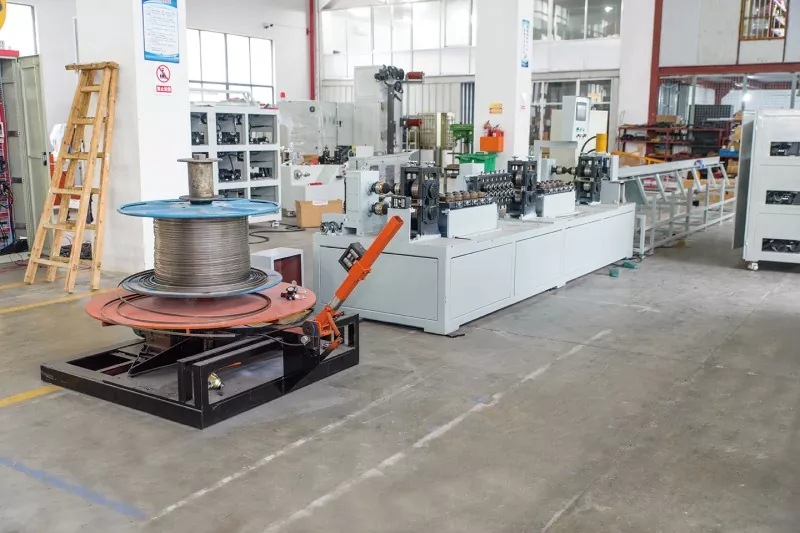
Walk through any recently commissioned rolling mill in China and you’ll notice fewer manual tweaks at the control desk. Operators no longer hover over levers, constantly compensating for strip wander or thickness drift. Instead, a closed-loop roll adjustment system reads real-time measurements from laser sensors and load cells, compares them against target profiles, and makes micro-corrections to roll gaps and tilts within milliseconds. What was once a premium option on high-end tandem mills has quietly slipped into the standard spec sheet for new Chinese lines—often without much fanfare, but with measurable impact on yield and downtime.
The shift didn’t happen overnight. Early adopters in the automotive and appliance steel sectors pushed suppliers to integrate closed-loop control as a default, not an upsell. Chinese equipment builders responded by embedding automatic gauge control and flatness feedback into their base packages, driven by competition and a domestic market that rewards through-put over manual craftsmanship. The result is a new generation of lines where the operator’s role shifts from constant intervention to exception handling—watching alarms, fine-tuning set points, and stepping in only when the closed loop hits a physical limit or a sensor anomaly.
There’s a quiet economics to this trend. Closed-loop systems cut cobble rates, reduce edge cracking, and allow thinner gauges at higher speeds without sacrificing profile consistency. For mills running 24/7 with thin margins, the payback comes not from a single dramatic improvement but from thousands of small avoided losses. And because the technology has become standardized, training new crews is faster—the system carries the know-how, not the veteran roller. Expect this quiet standard to spread further as older lines retrofit and export-oriented Chinese builders offer the same closed-loop package overseas.
High-Strength Alloys Are Outpacing Older Shaping Equipment
The machines that shaped metal for decades were built around assumptions that no longer hold. Older presses, rolls, and stamping lines were designed for steels and aluminum grades that yielded predictably under moderate force. When you feed a modern high-strength alloy into that same equipment, the material doesn't just resist—it fights back. Tooling wears faster, frames flex beyond tolerance, and the precise control needed for tight tolerances starts to drift. The result is a growing mismatch: the alloy is ready for the next product cycle, but the equipment is stuck in the last one.
This gap shows up most clearly in industries pushing for lighter, tougher components. A sheet of advanced high-strength steel can now be three times stronger than what a typical stamping line was rated for a generation ago. The older hydraulic systems simply can't deliver the tonnage or the fine speed control required to form it without cracking or springback. Maintenance teams compensate by slowing cycles and replacing dies more often, but that's a losing battle. Eventually, the line produces more scrap than sellable parts, and the financial logic of upgrading becomes impossible to ignore.
Some shops try to bridge the gap with partial retrofits—stronger bolsters, harder die coatings, or modified feed systems. These help for a while, but they can't change the fundamental architecture of a machine built for softer metals. The real shift happens when companies stop treating forming equipment as a long-term fixed asset and start viewing it as something that must evolve alongside material science. Otherwise, the alloy keeps improving while the shop floor stays anchored to yesterday's strength limits.
The Roll Material and Surface Finish Factors That Decide Final Tolerance
Roll material stiffness and hardness set the baseline for how much elastic deflection occurs under load and how quickly the surface degrades during a run. A forged steel roll with high modulus may hold a tight profile across the strip width, but its thermal expansion can still open the gap by a few microns if the mill speed changes suddenly. Cast iron rolls behave differently: they resist galling and often deliver a more stable friction condition, yet their lower toughness makes them prone to edge spalling when thin gauge strip is rolled at high reduction. These material-specific behaviors mean final tolerance is not just about roll grinding accuracy—it depends on how the roll body responds to heat, force, and time in service.
Surface finish contributes more than a simple Ra number. The direction and depth of the grinding pattern affect how lubricant is trapped in the bite and how metal transfer starts on the roll surface. A finish with low waviness and consistent peak spacing reduces local pressure spikes, so the strip exits with a more uniform thickness. But if the finish is too fine, the oil film can break down and cause micro-slip; if it is too coarse, the peaks wear quickly and change the effective roll diameter. Rolls that keep tolerance over long runs usually have a finish tuned to the lubricant viscosity and the metal being rolled, not just a generic mirror polish.
The real limiting factor often comes from the pairing of material and finish. A high-hardness roll can retain a precise surface texture for hundreds of coils, but only if the grinding operation does not introduce chatter or burn marks. Those defects create hard spots that then wear unevenly, producing periodic thickness variation. In practice, mills that map out which roll material holds a given surface finish longest under their specific coolant and reduction schedule gain a clear tolerance advantage over shops that treat material and finish as independent choices.
Tighter Incoming Wire Changes What Downstream Forming Can Achieve
When incoming wire arrives with a tighter diameter tolerance, the entire downstream setup becomes more predictable. Bending dies no longer need to compensate for a range of stock thicknesses, so tooling can be designed closer to the nominal dimension. That means the first hit produces a bend angle much nearer the target, and springback compensation stays valid across an entire coil.
The benefits extend beyond simple dimensional consistency. Tighter wire also tends to have fewer surface defects and more uniform mechanical properties along its length. This allows forming machines to run at higher speeds without worrying about sudden hardness spikes or localized thinning causing splits. Complex multi-stage forming operations—like upsetting a head then bending a leg—become repeatable enough to hold tight assembly tolerances without secondary sorting.
What this means in practice is that tighter incoming wire changes what is possible at the forming stage. Parts that once required machining from solid stock can sometimes be cold-formed directly, because the starting diameter is stable enough to control material flow precisely. Tool life improves as well, since the wire does not fight the tooling with unexpected dimensional variation. The result is a forming process that can achieve geometries and tolerances that were previously reserved for more expensive manufacturing methods.
Adaptive Shape Correction Is the Next R&D Focus for Chinese Suppliers
Chinese suppliers have long been recognized for their ability to deliver high-volume, cost-effective components, but the next wave of innovation is pushing them into more sophisticated territory. Adaptive shape correction, a process that uses real-time feedback to adjust manufacturing parameters and compensate for material inconsistencies, is emerging as a critical area of research. This shift is driven by the need to meet tighter tolerances in sectors such as electric vehicles, consumer electronics, and medical devices, where even sub-millimeter deviations can compromise performance or safety.
Unlike traditional post-production inspection, which often results in scrap or costly rework, adaptive correction integrates sensing and adjustment directly into the production line. By leveraging advances in machine vision, force sensing, and closed-loop control algorithms, engineers can now detect deformations during forming, machining, or assembly and immediately tweak tool paths or clamping forces. This not only reduces waste but also enables the use of lower-cost raw materials that would otherwise be rejected due to variability. Several leading Chinese manufacturers have already begun piloting these systems, reporting double-digit improvements in first-pass yield.
The competitive pressure to differentiate is intense. As global buyers increasingly demand not just low prices but also consistent quality and faster turnaround, adaptive shape correction offers a clear path to premium positioning. However, the technology is not without challenges: integrating sensors into harsh factory environments, handling the computational load of real-time optimization, and training operators to trust automated adjustments all require significant investment. Yet for suppliers willing to commit, this capability could become a defining advantage in an otherwise crowded market.
FAQ
Many Chinese production lines now use closed-loop servo systems and laser diameter gauges that adjust roll gaps in real time, keeping tolerances within plus or minus 0.01 mm instead of relying on manual spot checks like older equipment.
Modular roll cassette designs allow quick changeovers, so whether you are working with soft copper wire or hard stainless steel, you can switch from round to rectangular, square, or custom profiles without long downtime.
Yes, some newer designs integrate interchangeable forming stations after the flattening stage, and operators can switch products in about half an hour, which is especially useful for small batch orders.
Laser scanning and eddy current inspection systems collect hundreds of data points per second and send feedback to the PLC, automatically compensating for roll wear and material springback, which cuts scrap rates noticeably.
Many factories use alloy steel rolls and automatic lubrication systems, with continuous running times exceeding several thousand hours and longer maintenance intervals than previous generations, which has helped exports to Southeast Asia, the Middle East, and Europe.
Integrating drawing and flattening steps means you no longer need separate annealing and cleaning processes, so energy consumption drops by roughly 20 to 30 percent and wire breakage rates fall as well.
Pay attention to roll hardness, the brand of servo motors, how open the control system is, and whether the supplier offers remote diagnostics; it is also wise to request an on-site trial run and sample test report.
More manufacturers are experimenting with vision inspection and AI-assisted adjustments, allowing the machine to recognize surface defects on its own and fine-tune rolling force, moving toward fully unattended operation.
Conclusion
Precision metal forming in China starts long before the final stamped or bent part emerges. The accumulation of dimensional error, known as tolerance stack-up, begins at the flattening stage, where uneven incoming wire can doom downstream accuracy. Recognizing this, Chinese manufacturers have quietly integrated closed-loop roll adjustment into their newest flattening lines. These systems measure strip thickness in real time and automatically correct roll gaps, a feature once reserved for premium European equipment but now becoming standard on high-volume Chinese machines. This shift matters because high-strength alloys—used in automotive and aerospace components—are pushing older shaping equipment past its practical limits. Without adaptive roll control, springback and inconsistent hardness across a coil translate directly into rejected parts.
Beyond automation, the physical roll itself dictates what tolerances are achievable. Chinese suppliers now pay far closer attention to roll material selection and surface finish, choosing hardened tool steels or ceramic coatings that resist wear and maintain a consistent friction profile. A polished roll surface reduces micro-slip and prevents oxide pickup, both of which can distort thin strip. As a result, the incoming wire is flatter and more uniform than ever, which allows downstream forming operations—bending, stamping, coining—to work with far less compensation. Looking ahead, the next competitive frontier for Chinese line builders is adaptive shape correction, where vision systems and pressure mapping actively reshape the strip in transit. The goal is no longer just flattening; it is producing a strip so geometrically stable that even complex multi-stage forming yields consistent parts without manual tweaking.
Contact Us
Contact Person: Rayna
Email: [email protected]
Tel/WhatsApp: 86 -173 1474 6343
Website: https://www.grmrollingmill.com/