

ODM Commercial Heat Pump Systems: How to Choose the Right One for Your Business
2026-11-02
Choosing the right ODM commercial heat pump system isn't just about comparing specs—it's about finding a unit that fits your building's real-world load and your long-term service expectations. Too often, businesses settle for a cheap build and inherit undersized performance or vague warranties. That's why we put this guide together, with a closer look at how Tongbaote approaches engineering and support differently. Read on for the questions that should shape your decision.
Your Building's Load Changes Every Hour—Does the Heat Pump?
A building rarely asks for a steady-state output. Occupancy, solar gain, equipment use, and ventilation requirements shift from one hour to the next, and the heating or cooling demand follows. A fixed-speed heat pump doesn't follow that curve well—it cycles on and off, hitting full output or nothing, which leaves room temperatures swinging around the setpoint and adds wear to the compressor.
Inverter-driven heat pumps are different. By varying compressor speed and adjusting the expansion valve, they can throttle capacity down to roughly 20–30% of nominal output and ramp up when the load rises. That doesn't mean they react instantly; the refrigerant circuit and heat exchanger mass introduce a small lag, so a buffer tank or well-tuned control loop is often used to absorb short-term mismatches.
The smart play is to let the building's thermal mass work for you. Slab floors, concrete cores, and even well-insulated walls can store or release heat over several hours, smoothing the sharpest load swings before they reach the heat pump. With outdoor temperature compensation and a modest buffer volume, a variable-speed unit can ride through the hourly changes without constantly starting and stopping—doing its best work at part load, where efficiency is usually highest.
The Real Cost of a Cheap Commercial Heat Pump Shows Up by Year Three
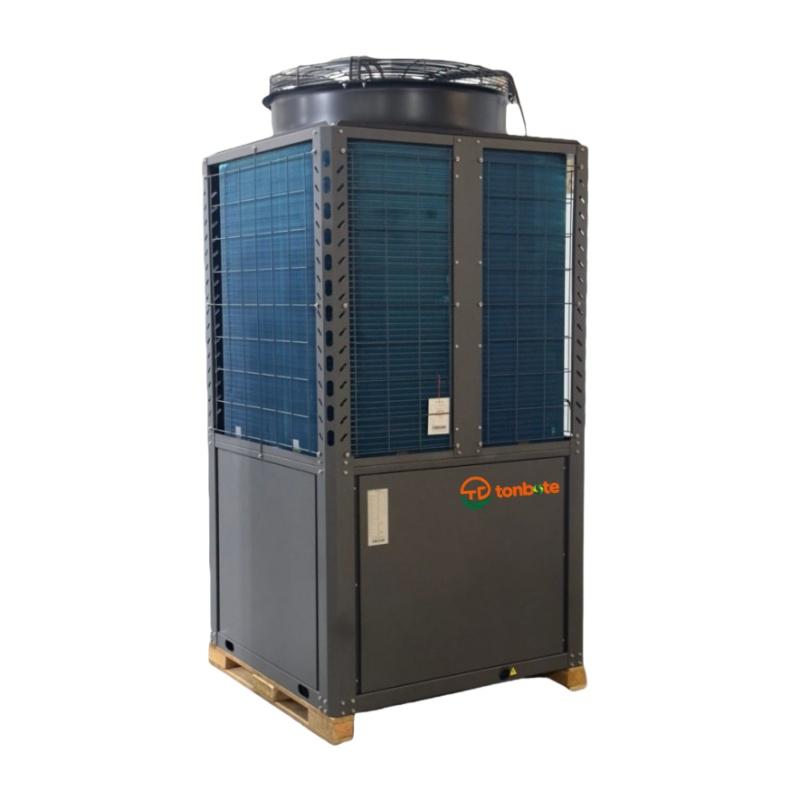
Most facility managers who choose a low-bid commercial heat pump feel a brief rush of relief when the invoice clears. That relief rarely survives the first two winters. By the third year, the pattern is unmistakable: rising energy consumption, frequent defrost cycles that never quite resolve, and a compressor that cycles harder than it should. Cheap units often ship with undersized coils, thin cabinet insulation, and controls that lack adaptive logic. They work just well enough during mild shoulder seasons, then bleed efficiency when temperatures drop and runtimes lengthen. What looked like a smart capital saving at procurement quietly morphs into an operating expense that compounds every month.
The hidden costs surface in predictable places. Refrigerant leaks appear at braze joints that were rushed through production. Reversing valves stick after repeated short cycling, forcing emergency service calls that never fit the maintenance budget. Defrost sensors drift out of calibration, so the unit either ices over or wastes heat stripping frost that is not there. None of these failures are dramatic enough to trigger a warranty replacement in year one or two. They are slow, nagging, and cumulative. By year three, a building owner is not just paying for repairs; they are paying for the lost productivity of a system that cannot hold setpoint during cold snaps, and for the overtime labor of technicians who know the unit by its serial number.
There is also the quieter cost of tenant discomfort. A cheap heat pump that struggles to maintain stable discharge air temperatures creates hot and cold zones that occupants notice long before the maintenance log does. Complaints rise, lease renewals stall, and the building's reputation takes a hit that no amount of after-hours service can fully erase. Meanwhile, the facility budget absorbs the real difference: the gap between the predicted lifecycle cost of a quality system and the unplanned spending that begins in month thirty. Smart buyers have learned to ask for three years of operational data from similar installations, not just a spec sheet. Because the genuine price of a commercial heat pump is never the number on the purchase order. It is revealed in the third winter, when the cheap unit is working its hardest, and failing at the worst possible moment.
Custom Refrigerant Circuits: The ODM Advantage You Can't Get Off the Shelf
Custom refrigerant circuits change how you approach a design. Off-the-shelf options tell you where the distributor sits, how many passes the condenser gets, and what pressure drop to accept. In an ODM engagement, those choices start from the product's actual cabinet depth, fan placement, and duty cycle. The result is usually a smaller charge, better oil return on low-ambient starts, and fewer compensations elsewhere in the system.
The difference becomes obvious when standard layouts stop working. A unit with a left-hand compressor and a narrow coil may need a split-circuit evaporator with a dedicated subcooling pass to hit capacity without flooding. A heat pump that runs heating-dominant seasons might want a different header arrangement than a cooling-first design. Those are not catalog options; they are line-item decisions in a custom circuit drawing.
Over the product's life, that tuning shows up in energy use and service calls. Matched circuit volumes, lower distributor pressure drop, and shorter liquid line runs reduce work for the compressor and keep refrigerant distribution even as filters load or fans degrade. You're not paying for a premium part. You're paying for the circuit to fit the machine instead of forcing the machine to fit the circuit.
Why Part-Load Efficiency Matters More Than a Single Lab Test Number
A single laboratory test number usually reflects one ideal operating point, often full load, where conditions are carefully controlled and flattering. Real equipment, however, seldom runs at that point. Most HVAC, pumping, and compression systems spend the overwhelming majority of their hours at 30% to 70% of capacity. A rating that only captures performance at maximum output therefore offers little insight into the energy draw you will actually experience day to day.
Part-load behavior shapes the real rhythm of energy consumption. When compressors modulate, fans ramp down, and heat exchangers operate at lower approach temperatures, small differences in unloading strategy or minimum turndown can quietly compound into large annual differences. A chiller or pump with an impressive full-load figure may still be a poor performer if it cycles erratically, hunts at low load, or cannot turn down deeply without losing efficiency.
Focusing only on a lab-rated number can also encourage oversizing, which pushes equipment even further into part-load territory and magnifies the problem. A more useful approach is to examine performance maps across multiple load and ambient conditions, or use a weighted seasonal metric that reflects actual operating hours. That broader view is far closer to what your utility bill will eventually show.
Don't Let a Standard Footprint Dictate Your Mechanical Room Layout
A standard mechanical room footprint usually assumes every piece of equipment sits neatly within an imaginary rectangle. That rarely matches real maintenance needs. Pulling a pump shaft or replacing a tube bundle can demand clearance the original rectangle never reserved. Before accepting a given layout, walk the service path with the largest removable component in mind. Shift the chiller or boiler a few inches off the grid to create a real pull lane, even if it breaks the symmetry.
Vertical space is often ignored when the floor plan feels fixed. Mounting small pumps, expansion tanks, or control panels on a mezzanine or high shelf can free up enough floor area for a proper valve station. In one retrofit, rotating a heat exchanger 90 degrees and sliding it against a rear wall turned a dead corner into a full coil-pull zone. The footprint stayed the same, but the room finally worked.
You don't always need more square feet; you need better sequence. Arrange equipment so the item with the longest service interval sits farthest from the door, while filters, strainers, and controls stay up front. An uneven row of pumps or an offset air separator may look less tidy on paper, but it can prevent shutdowns caused by blocked access. Let real maintenance tasks shape the boundaries instead of forcing the tasks into a stock footprint.
Commissioning and Controls: Where Most Heat Pump Projects Quietly Fail
The gap between a heat pump's rated COP and its real-world performance often opens during commissioning. Many installers treat the unit like a drop-in replacement for a gas boiler, leaving supply water temperatures high, bypass valves open, and circulator speeds mismatched. A heat pump needs its flow rate, delta T, and compressor staging verified against the actual load, but that work frequently gets squeezed into the last half-day of a project. The result is a system that never learns the thermal signature of the building and burns far more electricity than the design documents promised.
Controls add another layer of quiet failure. Poorly tuned weather compensation curves cause the heat pump to chase outdoor temperatures too aggressively or not enough, leading to short cycling in mild weather and underheating during cold snaps. Sensor placement is just as critical: an outdoor sensor hit by direct sun or a return water sensor sitting too close to the buffer tank will feed the controller a distorted picture. Once the logic starts reacting to phantom loads, the heat pump hunts, auxiliary heat kicks in prematurely, and the homeowner ends up paying for resistance heat without ever seeing a warning light.
Multi-source integration is where even well-installed units stumble. A heat pump that shares a hydraulic system with a wood boiler, solar thermal array, or electric backup requires explicit mode switching and priority rules. Without that, the backup source fires at the wrong times, or the heat pump locks out under conditions it could easily handle. The absence of simple monitoring—flow temperatures, energy metering, run-time hours—means these faults stay invisible for months. By the time someone notices the high bill or cold radiators, the project has already become another quiet failure attributed to heat pumps in general, when the real culprit was the commissioning sheet that never got filled in.
FAQ
Start with the actual heating and cooling load of your building, not just square footage. Then verify the unit's capacity at the ambient temperatures your region actually sees, because nominal ratings often don't reflect real winter or summer performance.
Ask for examples of previous non-standard projects and the engineering team's involvement during design. A capable ODM partner will discuss refrigerant circuit changes, control logic tweaks, and packaging adjustments without pushing you toward an off-the-shelf model.
Yes, it changes the compressor and defrost strategy. In colder areas you'll want enhanced vapor injection or a cascade setup, while hot humid regions require careful attention to dehumidification and condenser sizing so efficiency doesn't drop during peak loads.
Beyond the purchase price, you may face repeated service calls, poor parts availability, and controls that don't integrate with your building management system. Retrofitting or replacing a bad match usually costs far more than paying for proper engineering upfront.
A slightly higher unit price often pays for itself if the manufacturer offers responsive technical support, local spare parts, and clear documentation. Downtime in a commercial setting is expensive, and waiting weeks for a replacement board can erase any initial savings.
Absolutely. Many established ODMs will agree to a sample order or a limited trial run so you can monitor noise, energy use, and reliability in your actual conditions. If a supplier refuses any trial option, treat that as a warning sign.
Request the test reports that match your target market, such as AHRI, CE, or ETL listings, and ask about refrigerant safety and performance under partial load. Independent lab data is more trustworthy than in-house marketing numbers, especially for commercial projects.
Conclusion
Selecting a commercial heat pump usually starts with a spec sheet, but the real decision gets made months later when the building's cooling and heating loads drift hour by hour and the unit either tracks those swings or fights them. Off-the-shelf equipment tends to lock you into a single performance point, so a machine that looks efficient at full load can spend most of its life short-cycling at part load and burning through compressors. ODM systems earn their keep by matching compressor staging, fan control, and refrigerant circuit design to the way your building actually behaves—not to a single lab test number. Cheap units often hide their true cost until year three, when coil corrosion, refrigerant leaks, or control board failures start eating into the savings that looked attractive on the bid. Custom refrigerant circuits let you size heat exchangers and valve arrangements around your specific load bands, something no standard catalog can match.
Mechanical room constraints are another reason to avoid forcing a standard footprint into an existing layout. An ODM partner can shift connections, rework coil orientation, or split modules so the heat pump fits without expensive piping rework or sacrificed service access. Yet even the best hardware underperforms if commissioning is rushed. Most heat pump project failures are quiet ones: sensors left uncalibrated, sequence logic that never gets tested under low ambient or high humidity, and controls that default to a generic curve instead of the building's measured response. A sensible selection process therefore treats commissioning, controls integration, and part-load verification as non-negotiable deliverables—not as line items to trim when the schedule tightens. That is how the right ODM commercial heat pump system proves itself by year three and beyond.
Contact Us
Contact Person: Wanshu Chen
Email: [email protected]
Tel/WhatsApp: +86-13662871206
Website: https://www.mbcee.com