
OEM Wine Production Line Maker for Crafting Custom Turnkey Winery Solutions
2026-11-02
Every winery has a unique story, but too many are forced into a one-size-fits-all production line that dilutes their craft. That’s where INTOP Machinery changes the game—as an OEM wine production line maker, we design and build custom turnkey winery solutions from grape reception to bottling, so you can scale without compromising your signature style. In this post, we’ll walk you through what truly tailored equipment means for your yield, quality, and bottom line.
Your Grapes Deserve a Production Line Built for Them
Most winery equipment still treats every load of fruit the same way, but your blocks don’t ripen in lockstep. A production line built for your grapes starts with a receiving hopper and conveyor that match the exact size of your picking bins, not a one-size-fits-all chute. That means less tipping, less fruit crushing before processing even begins, and fewer forklift passes in a tight crush pad.
The next stage should respect cluster integrity instead of ripping stems out at full speed. Adjustable destemmer RPM and cage spacing let you slow things down for thin-skinned varieties or speed up for small-berried clusters. Whole berries stay intact through sorting, so you avoid tearing skins and releasing bitter seed tannins before fermentation has a chance to extract on your terms.
A truly built-for-you line also changes over quickly between lots. Quick-release chutes, tool-free guard panels, and sloped catch trays cut cleaning time and keep one vineyard block from blending into the next. Small-batch wineries can run a half-ton of Pinot then switch to Syrah without losing a morning to hose-downs. That level of control only comes when the equipment follows your fruit, not the other way around.
What Turnkey Actually Looks Like Inside a Custom Winery Build
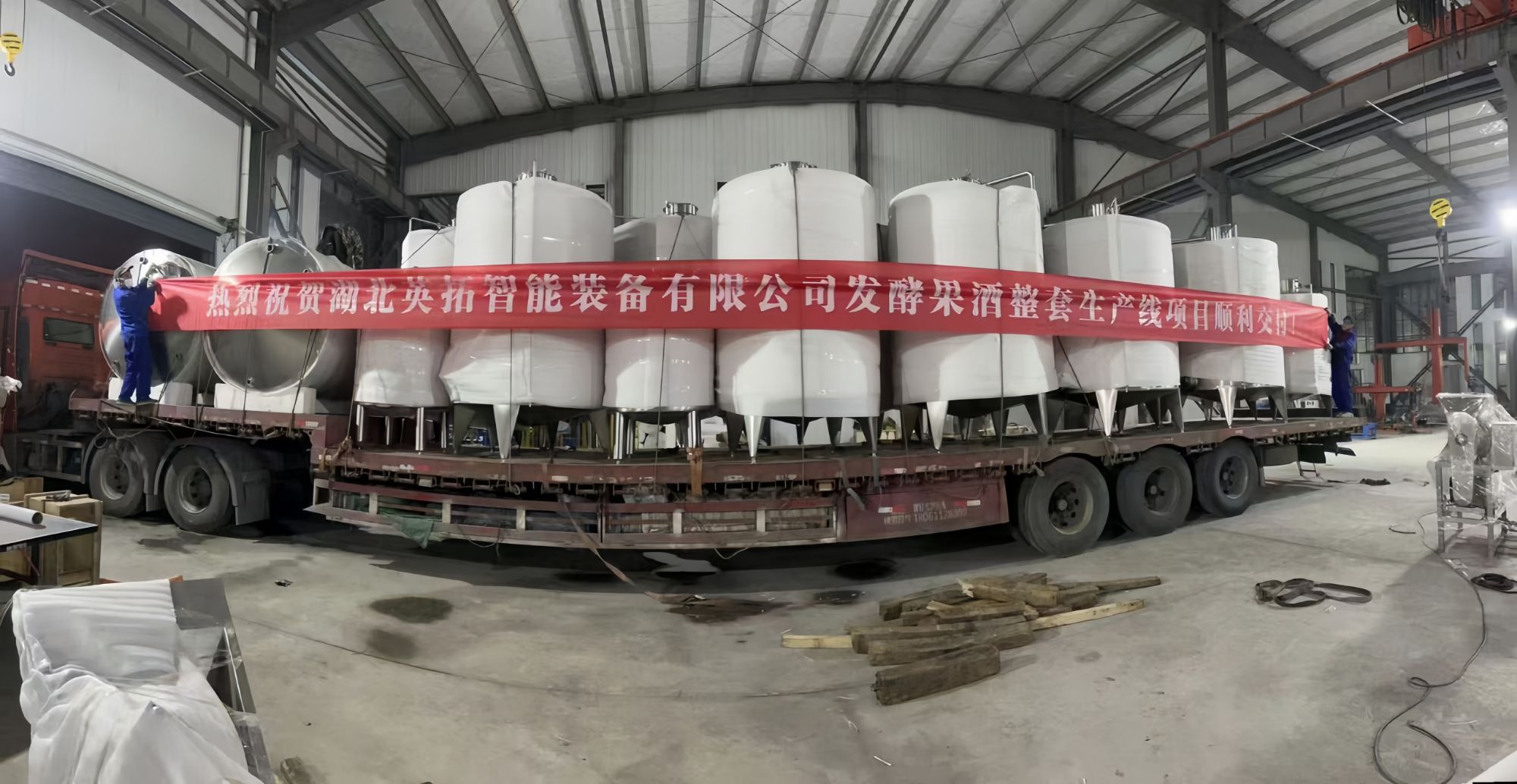
Walk through the roll-up door on a finished turnkey winery and the first thing you notice is how little you have to think about. The crush pad isn't just a slab of concrete; it's graded so a spilled bin of grapes drains toward a slotted trench that actually flows. Stainless tanks stand in a row with their glycol supply and return lines labeled in faded marker, valves within arm's reach, and a pressure gauge on every jacket. The builder didn't just drop equipment on a floor—they ran the hard piping, wired the control panels, and left a binder of as-built drawings on the small stainless table by the door.
In the barrel room, the difference between a kit and a true turnkey build shows up in the details you'd never spec yourself. The humidifier kicks on when the sensor near the back wall drops below 70%, and the exhaust fan pulls air across the top of the barrel stacks without rattling the light fixtures. There's a small sink with hot water, a pH meter mounted on a swing arm, and a quad outlet exactly where you'd park a transfer pump. Even the floor coating is a two-part epoxy that doesn't peel under tartaric acid spills, because someone thought about what actually happens during a racking.
Then you open the door to the side room that most winery plans forget: a narrow closet with a slop sink, a hose reel, and enough shelving for spare gaskets and filter pads. The turnkey contractor left the compressed air line coiled above the workbench, tested it for leaks, and labeled the shutoff valve. There's no punch list taped to the wall because the lights, the waste line, the temperature alarms, and even the little paper towel dispenser all work the day you get the keys. That's what turnkey means inside a custom build—not a showroom, but a room where you can crush, press, and pump without cursing the person who installed the drain uphill.
From Vineyard Map to Fermentation Tanks: The Design Step
The first sketch began with a hand-drawn contour map of the hillside vineyard, its faint pencil lines marking every slope change and drainage swale. Those subtle grades would later determine not just where the tanks sat, but how the must flowed by gravity from crush pad to press. Early on, we taped the map to the wall of the barn and traced our fingers along the rows, arguing about block orientation and the angle of the afternoon sun. The design step wasn't tucked away in some office; it happened right there with the smell of fermenting fruit already in the air.
Once the tank layout was roughed in on paper, the real test came with a mock-up using old oak barrels and rope to trace the pipe runs. We measured the fall from the sorting table to the first fermentation tank—just over four feet, enough for a gentle, unforced transfer. Each tank's placement had to respect the existing concrete pad, the reach of the forklift, and the way the winemaker liked to walk between rows with a sample thief in hand. Nothing felt theoretical; every inch was tied to a chore, a tool, or a habit.
By the time the final drawings were done, the design had absorbed dozens of small compromises: a slightly smaller tank here to keep a clear sightline to the vineyard, a raised catwalk there to match the height of the old press, a corner left open for a future glycol chiller. The map and the tanks spoke the same language, one of slopes, gravity, and the slow, deliberate pull of grapes into wine.
Why Your Bottle Shape Should Dictate the Filling Line
The curve of a bottle's shoulder, the length of its neck, and the width of its base all change how liquid enters, how air escapes, and where foam settles. A tall, slim profile needs a slower fill and a deeper vent tube to avoid splashing and overflow. A short, wide container can often take a higher fill speed, but it may need a different nozzle position to keep the stream centered and prevent aeration.
Headspace is another factor tied directly to shape. Two bottles can hold the same volume, yet a long-necked design leaves less exposed surface area after capping, while a broad-shouldered bottle traps more air during filling unless the vent timing is adjusted. Filling to a fixed height by eye can therefore produce inconsistent oxygen levels across different silhouettes.
Line speed and downstream handling also follow the bottle profile. A tapered body or rounded base may rock slightly on the conveyor at high throughput, so guide rail spacing and fill-to-level sensors need to be matched to the exact contour. When the filling line is set around the bottle's geometry first, changeovers become faster and fill accuracy holds steady from the first container to the last.
OEM Partnership Without the Usual Hand-Off Headaches
When we start an OEM engagement, the first thing we do is assign a single engineering contact who stays with your project from prototype to final assembly. No more re-explaining design intent or fighting through layers of account managers.
That continuity matters because most hand-off friction comes from lost details: a tolerance that was never written down, a fixture that got modified in testing, a cable routing decision made over a video call. We keep a living hand-off document that updates with every build, so what we know is exactly what your team receives.
The result is a partnership where your production line doesn't stall while someone pages through old emails. Specs, test results, and revision history travel together, and anyone on your side can pick up the file and see the full picture.
The Difference Between Assembled Equipment and an Engineered Line
Assembled equipment typically arrives as pre-built modules or standalone machines that can be bolted into place and wired up with minimal on-site configuration. Think of a packaging conveyor or a bottling filler purchased from a catalog—it's designed to meet a broad set of common specs, and any customization happens through optional add-ons rather than fundamental redesign. This approach works well when throughput requirements are modest, floor space is flexible, and the product family won't change dramatically over the line's lifespan.
An engineered line, by contrast, is conceived from the ground up around a specific production goal. Engineers map out every transfer point, buffer zone, and control interface before any metal is cut. The result is a tightly integrated system where each station feeds the next at exactly the right rate, often incorporating custom tooling, proprietary software logic, and safety interlocks that reflect the actual risks of that particular process. You'll see this in high-speed beverage filling lines, automotive body shops, or pharmaceutical aseptic processing—anywhere that a few percentage points of efficiency or a single contamination event can swing millions in annual profit.
The real distinction shows up during commissioning and future changes. Assembled equipment may run in days but often leaves you stitching together disparate PLCs and dealing with bottlenecks at the interfaces. An engineered line takes longer to design and debug upfront, yet it behaves like a single organism: diagnostics are centralized, changeovers are scripted rather than improvised, and capacity expansions are planned into the original layout. Choosing between them isn't about good versus bad—it's about whether your process tolerates a generic fit or demands a tailored one.
FAQ
It covers everything from grape receiving, crushing, pressing, fermentation, filtering, aging, to bottling and labeling. We also supply the interconnecting pipes, PLC control system, and perform on-site installation and commissioning. The tank sizes and pump configuration are adjusted to match your grape varieties and annual output.
Yes, we regularly build compact lines for 5,000 to 20,000 liters annual production. We can lower the height of tanks, use variable-speed pumps, and design mobile crusher-destemmers that fit narrow cellar doorways.
We use 304 or 316L stainless steel with argon-shielded welds and electro-polished interiors to prevent micro-cracks and oxidation. All transfer lines are sloped and have minimal dead legs to reduce oxygen pickup.
After finalizing the layout and P&ID, it usually takes 12 to 16 weeks for manufacturing, plus 2 to 3 weeks for ocean freight and 1 week for on-site commissioning. We can expedite if you need it before harvest.
Yes, we provide remote monitoring setup, a one-year warranty on pumps and controls, and optional on-site training for your cellar team. We also keep a stock of critical spares in our regional warehouse.
Absolutely. We can adapt our conveyors, pumps, and PLC program to work with your current vessels, as long as we receive accurate dimensions and nozzle positions. This often cuts project cost by 20-30 percent.
Instead of forcing your process into fixed modules, we start with your target wine style and bottle format. Then we adjust pipe diameters, pump speeds, and control sequences to reduce maceration time or preserve aroma, depending on what you need.
We build all control cabinets with multi-voltage transformers and supply both CE and UL certified components. Before shipping, we test the full line at your voltage and frequency, and we provide wiring diagrams that match your local code.
Conclusion
A winery is not a generic factory, and the equipment that turns grapes into bottled wine should not be generic either. An OEM wine production line maker focused on custom turnkey solutions starts by looking at your vineyard, your varieties, and your fermentation capacity—not by pulling a standard layout off a shelf. The design phase maps everything from vineyard rows to tank placement, so the crush pad, presses, and pumps fit the actual flow of your harvest. If your bottles have an unusual shoulder or weight, the filling line is engineered around that shape rather than forcing your package to adapt to a standard machine. This approach removes the common gap between sold equipment and a working line: every conveyor, filler, corker, and labeler is chosen to work as one system, not merely bolted together.
The real value of a turnkey OEM partnership shows up when the hand-off happens. Instead of juggling multiple vendors and hoping their machines communicate, you get a single team that owns the integration from grape receiving to finished case. Your grapes deserve a line that respects their handling limits, and your production staff deserves equipment that does not demand constant workarounds. When the line is engineered rather than just assembled, the difference appears in reduced downtime, cleaner changeovers, and a bottling hall that feels like it was built for your winery, not adapted to it.
Contact Us
Contact Person: Laura
Email: [email protected]
Tel/WhatsApp: +86 13957758832
Website: https://www.intopmachinery.com