

Threaded Ball Valve Company Buying Guide for Engineers and Contractors
2026-11-16
Engineers and contractors know that a threaded ball valve is only as good as the company behind it—and with countless suppliers claiming the same specs, finding one that actually delivers can feel like a gamble. This buying guide cuts through the noise, and if you're looking for a manufacturer that stands behind every thread and seal, UPTAI is a name worth your attention.
Threaded Ball Valve Sizing and Pressure Class Selection
Sizing a threaded ball valve rarely starts with the pipe diameter. Although matching line size is common, the actual requirement is tied to flow rate, allowable pressure drop, and the valve's Cv. For on/off service, a full-port valve may keep pressure loss negligible, but if the system can tolerate some restriction, a reduced-port model often costs less and leaves room for actuation torque margins. Checking the Cv against the target flow at expected differential pressure prevents the mistake of assuming a 1-inch valve is correct just because the pipe is 1-inch.
Pressure class selection depends on the maximum working pressure and temperature, not just the cold rating. A threaded ball valve rated Class 600 may appear overqualified at room temperature, but once steam or hot oil pushes the operating point into a derated portion of the pressure-temperature curve, Class 300 could fall short. Threaded end connections also impose their own limits; NPT joints tend to weaken under cyclic thermal stress, so a 2000 WOG rating on the body does not automatically mean the threads will survive the same pressure at elevated temperature.
One practical approach is to select the pressure class first using the worst-case process conditions, then revisit sizing to confirm the chosen valve still delivers an acceptable Cv. If a Class 600 threaded ball valve in the required size has a reduced bore, the higher pressure rating might force a larger line size or a different connection style. Balancing these factors upfront avoids field modifications and keeps the installed valve within its safe operating envelope.
Material Compatibility for Aggressive Fluids and Environments
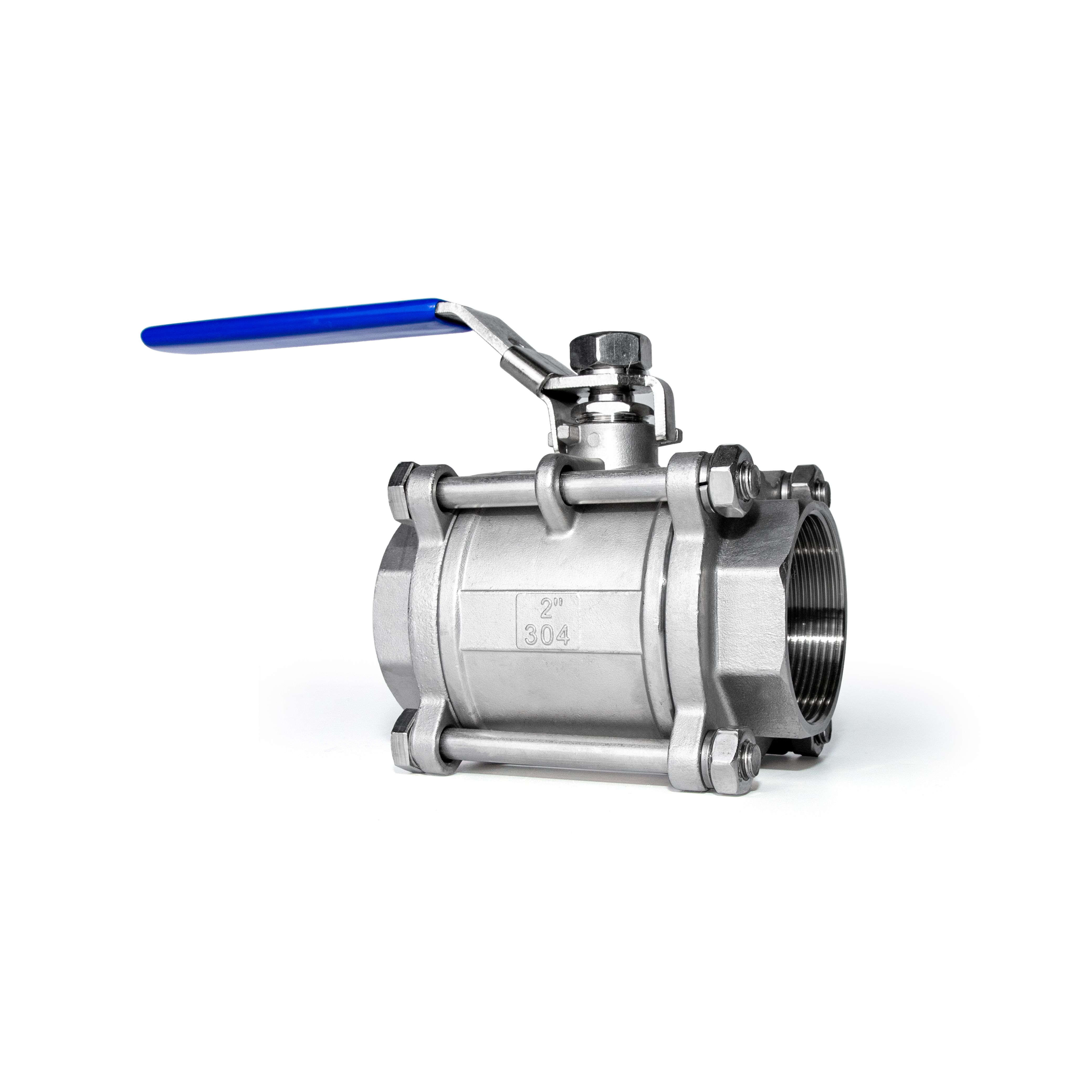
Selecting materials for aggressive fluids starts with a clear understanding of the chemical species involved—acids, bases, solvents, oxidizers—and the operating conditions such as temperature, pressure, and flow velocity. Generic compatibility charts often mislead because they ignore synergistic effects or concentration ranges. A stainless steel that handles nitric acid at room temperature may fail quickly in hot chloride-containing streams, while a fluoropolymer like PTFE offers broad chemical inertness but lacks the mechanical strength needed for high-pressure fittings. Engineers need to cross-reference actual case data or run targeted exposure tests rather than relying on broad material families.
Failure mechanisms vary widely across material classes. Metals may suffer uniform corrosion, pitting, or stress corrosion cracking when tensile stress aligns with a corrosive environment. Polymers can swell, lose plasticizers, or undergo chain scission, leading to embrittlement or softening. Elastomers in seals and gaskets often harden or degrade when exposed to strong oxidizers or hot oils. Mixed-fluid scenarios—common in cleaning agents or process byproducts—can produce unexpected attacks, so compatibility validation should include long-term immersion under worst-case conditions. The goal is not just avoiding immediate leaks but ensuring dimensional stability, sealing integrity, and safe service life over the entire operating envelope.
Seat and Seal Options for Long-Term Leak Prevention
Long-term leak prevention depends heavily on how well the seat and seal interface maintains integrity under changing pressures, temperatures, and media. Rather than defaulting to a single generic material, we evaluate the specific operating envelope first. For chemically aggressive streams or high-purity applications, PTFE and modified PTFE seats remain a solid baseline, but they can deform under sustained load. Reinforced options, such as glass-filled or carbon-filled PTFE, reduce cold flow and keep the sealing lip stable over thousands of cycles.
Metal-seated designs offer a different path when elastomers or polymers would degrade too quickly. A hardened stainless or Stellite seat paired with a matched seal ring handles abrasive slurries and elevated temperatures without the typical extrusion failures. The trade-off is usually a slightly higher leak rate at low differential pressures, so we often specify a dual-seal arrangement: a soft primary insert for tight shutoff and a metal backup that limits deformation when the insert eventually wears.
Beyond material choice, the actual geometry of the seat pocket and seal retention matters more than most datasheets imply. A properly undercut groove with controlled compression stops the seal from rolling or twisting during pressure reversals. For continuous-duty systems, we also recommend live-loaded gland followers or spring-energized seals that compensate for thermal expansion and creep without manual retorquing. These small details keep a valve from developing a slow weep after six months in service.
End Connection Standards and Installation Pitfalls
Every termination method—whether threaded, flanged, welded, or grooved—demands a precise match between the fitting and the pipe end. Ignoring the subtle differences in thread taper, flange face finish, or groove depth can lead to slow leaks that only appear after pressure cycling. Too often, installers rely on visual inspection alone, but a proper connection starts with verifying the actual dimensions against the manufacturer's tolerance sheet, not just giving a quick nod to appearance.
A common trap is overtightening threaded joints in an effort to stop a weep at the joint. This often strips the thread or cracks the female fitting, especially in brass or stainless systems. Instead, the sealant should do the work: a few wraps of PTFE tape in the direction of the thread, or a small amount of anaerobic pipe dope, followed by hand-tight plus a quarter turn. For flanged connections, uneven bolt torque warps the flange and creates a gap on one side—always use a star pattern and three passes, increasing torque gradually.
Finally, never bury a connection before it has been pressure-tested. Even a small air bubble in a welded socket or a nick on a groove can hold fine at low pressure but fail when the system is fully charged. And if you must transition between materials—say, copper to steel—use a dielectric union to prevent galvanic corrosion, or you'll be tearing out the joint within a year. The best installations are those where the connection itself is treated as a component, not an afterthought.
Actuation Choices: Manual, Electric, or Pneumatic
Selecting how a valve or actuator moves often starts with what's already available on the floor. A manual lever or handwheel costs little and never needs wiring or air lines, but it requires someone to be physically present every time a change is needed. That works fine for setups that rarely adjust, yet it becomes a bottleneck as soon as operators are juggling multiple stations.
Electric actuation brings precise positioning and easy integration with control panels or PLCs. You get clean operation without compressed air infrastructure, which matters in labs or spaces where noise and maintenance are concerns. The trade-off is that electric units tend to cost more up front and can be slower to respond in high-cycle applications unless you spec them carefully.
Pneumatic actuators remain the go-to for fast, repetitive motion in plant environments. They are simple, rugged, and typically cheaper at larger sizes, but they demand a reliable air supply and regular attention to fittings and seals. In many cases, the final choice comes down to whether speed, precision, or infrastructure cost carries the most weight for a particular line.
Testing, Certifications, and Traceability for Critical Projects
For critical projects, testing isn't a checkbox—it's the reason a structure stays up during a seismic event instead of buckling under load. Every batch gets a mix of destructive and non-destructive checks, from tensile and impact to full radiographic scans. If a plate can't prove its toughness at -40°C, it never leaves the warehouse.
Certifications and traceability work together when the stakes are high. Each heat number links back to the original melt, the exact chemistry, and the name of the technician who ran the Charpy test. Auditors don't get a folder of generic PDFs; they get a live chain from the mill to the final installation torque. That level of documentation isn't bureaucratic overhead—it's what keeps a critical project defensible under scrutiny.
FAQ
Look for the valve's pressure class stated against ASME B16.34 rather than a vague WOG number. A 600 WOG rating alone doesn't tell you the material group or temperature ceiling. Ask for the full pressure-temperature curve; if it's missing, move on. Also confirm the thread standard is ASME B1.20.1 and the end connections are NPT, not just 'standard pipe thread.'
Check the bore diameter against the nominal pipe size. A 1/2-inch full-port should have a bore close to 0.5 inches, not 0.375. You can pass a properly sized drill bit or ball gauge through the ball opening when the valve is open. Many reduced-port valves get sold as full-port because the threaded ends are full size, so don't rely on the outside.
NSF/ANSI 61 and NSF/ANSI 372 are the ones to request, not just a generic 'lead-free' claim. The 61 covers health effects from materials in contact with drinking water; the 372 verifies low lead content. For the valve body, ask for the specific ASTM grade—CF8M or CF8—and the heat number, not just 'stainless steel.'
Often the metal is thinner or the ball is a lower-grade alloy like 304 instead of 316. The stem seals may be PTFE but the seat could be a cheaper polymer that cold-flows. Also check if the handle is stainless or zinc-plated carbon steel. A low price on a valve that fails after 200 cycles costs more in callback labor than the upfront difference.
Request the saturated steam pressure-temperature rating, not just cold working pressure. A valve rated 1000 WOG might only handle 150 psi at 366°F. For compressed air, the seat material matters more than the body rating—RTFE or reinforced PTFE holds up better than virgin PTFE above 300°F. Ask for the seat's maximum continuous service temperature in writing.
Look at the stem design: a bottom-loaded stem with an internal shoulder meets the intent. Ask the supplier to confirm the stem is inserted from the inside and cannot be removed while the valve is under pressure. If they only mention an external nut or handle stop, that's not blowout-proof. Request a cross-section drawing and check that the shoulder bears against the body.
Ask how many units of the specific size and material are sitting in a warehouse you can actually audit. A real supplier keeps deep stock of common sizes like 1/2 through 2 inch in 316 stainless and carbon steel, not just 'available in 3-5 days.' Also check if they ship partial orders or hold everything for the last item—site crews hate waiting on backorders. A company with a local or regional distribution center usually turns around threaded valves same-day.
Only when the service involves sour gas or fluids with H2S. The NACE standard limits hardness and requires specific heat treatment, which adds cost. Don't pay for it on a standard water or air line—you're just buying documentation. But if the valve goes into an oil and gas battery, wellhead skid, or refinery unit with potential H2S exposure, the extra cost is cheap insurance against sulfide stress cracking.
Conclusion
Sizing a threaded ball valve goes far beyond matching pipe diameter. Engineers should verify that the pressure class of the valve aligns with the weakest link in the system, not just the pump or compressor rating, because thermal expansion and water hammer often push transient pressures beyond steady-state values. For aggressive fluids, 316 stainless steel is a common default, but chlorides, acids, and high-temperature process streams may demand duplex, Hastelloy, or PTFE-lined bodies. Equally important are the seat and seal materials: standard PTFE works for many applications, yet it can deform under frequent cycling or high temperatures, so reinforced PTFE, PEEK, or metal-seated options become necessary for long-term leak prevention. On the installation side, end connection standards remain a frequent failure point. NPT threads require the right sealant and torque practice, while confusing NPT with BSPT or failing to check thread engagement leads to slow, hard-to-find leaks.
Actuation should be driven by duty cycle and control requirements, not just budget. Pneumatic actuators handle fast cycling and fail-safe needs well, electric actuators suit remote or modulating control, and manual levers are best reserved for low-cycle isolation points. Finally, for any critical project, testing and traceability cannot be an afterthought. Require hydrostatic or pneumatic test certificates, material test reports tied to heat numbers, and serial-number traceability from body to trim. A supplier that hesitates on these documents is a risk, not a partner. The best threaded ball valve companies walk you through sizing, material selection, seal choices, and installation pitfalls before you place an order, helping you avoid shutdowns that cost far more than the valve itself.
Contact Us
Contact Person: Adonis
Email: [email protected]
Tel/WhatsApp: 8615858822657
Website: https://www.uptaivalve.com