

Top 10 Steel Purlins for Stronger Roof and Wall Support
2026-11-02
Picking the right steel purlins isn't just about ticking a box—it's about whether your roof and walls hold up under real stress. With so many profiles, gauges, and coatings out there, even experienced builders can second-guess which option actually earns its place in the frame. That's why we've narrowed it down to the top 10 steel purlins for stronger roof and wall support, drawing on field-tested performance data and practical insights from LANYUN to help you skip the guesswork and build with confidence.
Why Steel Purlins Outperform Wood for Long-Span Roofs
Long-span roofs need members that resist deflection without sagging over time. Steel purlins, rolled to precise dimensions, have uniform strength along the full length. Wood, by contrast, varies board to board and even within a single piece; knots and grain irregularities create weak points that show up exactly where bending moment is highest. For spans beyond roughly 6 meters, standard timber sections become heavy and still deflect noticeably, while a light-gauge steel purlin carries the same load with less depth and less dead weight.
Moisture and temperature changes also work against wood. Timber purlins shrink, twist, and lose bearing area as they dry, which can loosen roof fixings and create visible waviness along the eave line. Steel purlins stay dimensionally stable from the day they are installed, so the roof plane remains flat and fasteners stay tight. In long-span applications, that stability matters more than initial cost because correcting a sagging roof line later means tearing off cladding.
There’s also a practical advantage on site. Steel purlins arrive pre-cut and pre-punched for bolts and services, so a two-person crew can set a full bay in a morning with a scissor lift and a drill. Long timber purlins, on the other hand, often need a crane just to place each member, and field notching for connections adds labor and weakens the section. When span, speed, and straightness all count, steel leaves less room for error.
C-Channel vs. Z-Channel: Which Profile Handles Your Load Best?
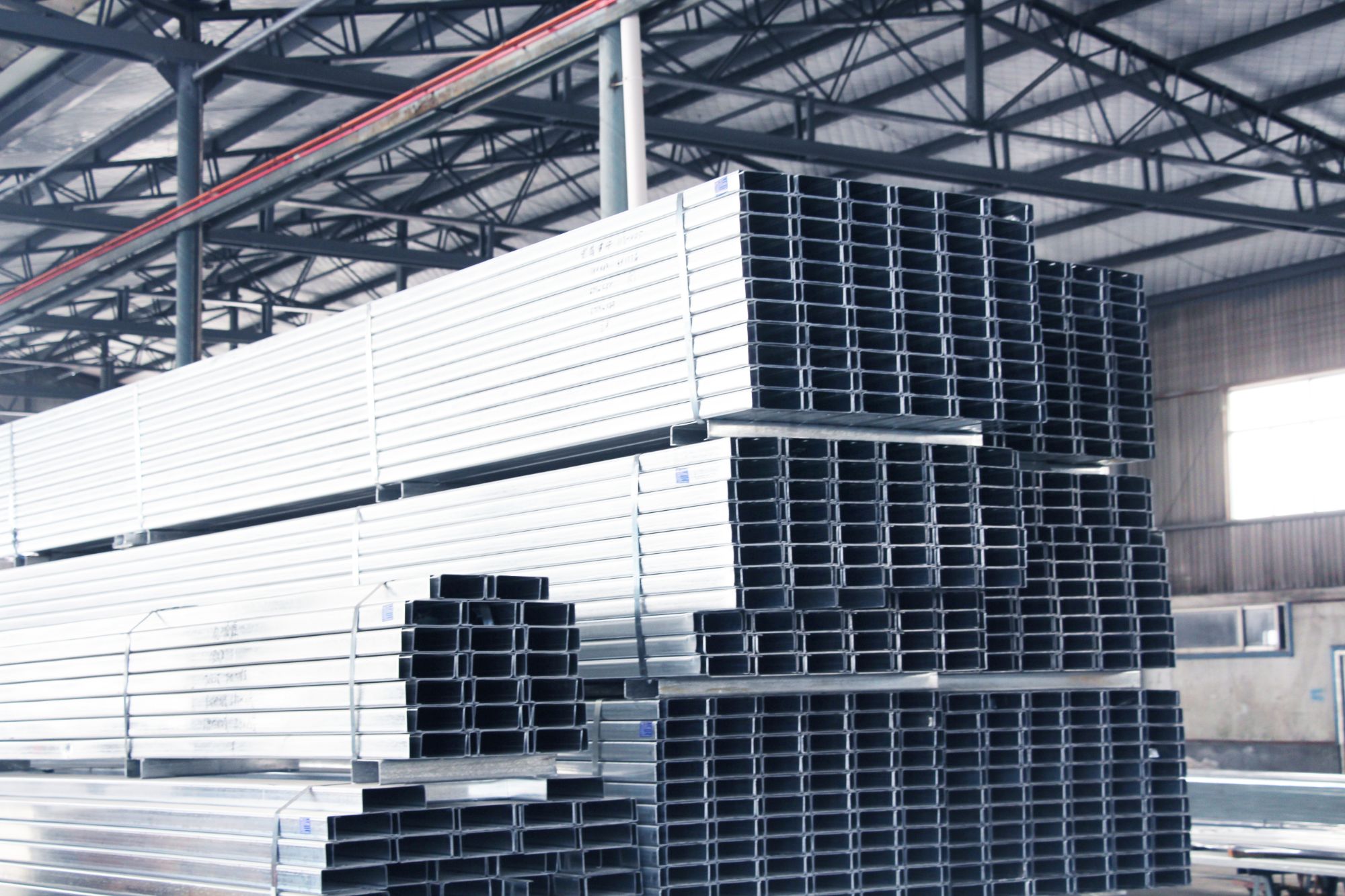
C-channel and Z-channel profiles look similar at a glance, but their load paths diverge quickly. A C-channel carries bending primarily through its web, with the two flanges on the same side of the web creating an open section that is easy to bolt but has an offset shear center. That offset means a load applied to the face of the web, or even slightly off the flange centerline, introduces torsion before you get pure bending. If your connection or bracing can restrain that twist, a C-channel works fine; if it cannot, you will notice lateral movement or premature buckling.
Z-channel shifts the flanges to opposite sides of the web, which brings the shear center much closer to the centroid of the section. Under a top-flange load from roof sheeting or floor deck, this reduces the tendency to rotate about the longitudinal axis compared to an equivalent C-section. That is one reason Z purlins get used in metal building systems where the sheeting attaches directly to the top flange and provides only partial lateral restraint. The shape is less convenient for bolting through both flanges, but it pays off in torsional stability.
Real-world selection often comes down to how the profile is supported. Z-sections can be lapped at the supports, allowing a longer piece to behave as a continuous member over two or more spans, which lowers peak moment and deflection. C-sections typically butt at supports and need a sleeve or a heavier bracket to achieve the same continuity. If your load is uniform and the span can be optimized with overlaps, the Z-profile usually handles the same load with less steel. If the framing is simple, side-loaded, or requires many field-bolted connections, the C-profile remains easier to work with.
Gauge and Yield Strength: The Real Factors Behind Sag Resistance
When a metal panel is installed horizontally, gravity works relentlessly against it. The material's own weight tries to pull it downward between supports, and that's where sag begins. Two material properties quietly determine whether the panel holds its line or droops noticeably: gauge and yield strength. Gauge dictates the cross-sectional thickness, which directly governs stiffness—a thicker sheet resists bending more effectively because its moment of inertia climbs with the cube of thickness. But thickness alone is only half the story. Yield strength sets the stress level at which the metal stops behaving elastically and begins to deform permanently. If the stress from self-weight stays below the yield point, the panel springs back to flat; if it creeps above, even by a small margin, a subtle but permanent sag takes hold.
The interplay between these two factors isn't linear, and that's why simply choosing a heavier gauge doesn't always solve the problem. A low-yield-strength alloy in a thick gauge might still sag under long spans because its elastic limit is easily reached under its own bulk. Conversely, a high-yield material in a thinner gauge can often outperform a thicker, softer alternative because it maintains its stiffness without crossing into plastic deformation. Designers who treat yield strength as a ceiling and gauge as a lever can fine-tune the balance: every increase in thickness buys more resistance, but only up to the point where the added weight itself raises the bending stress. The sweet spot lies where the cross-section is just thick enough to keep peak stress comfortably below the yield point, with a safety margin that accounts for thermal expansion, live loads, and installation tolerances.
In practice, sag rarely announces itself suddenly. It accumulates as a slow, creeping deflection that worsens with time if the material operates too close to its yield limit. That's why field failures often trace back to a miscalculation of effective span or an underappreciation of how much a panel's own weight increases with gauge. The most reliable approach treats sag resistance as a two-variable problem: match the yield strength to the span and dead load, then select the thinnest gauge that still keeps stress within a conservative fraction of the yield point. Ignore either factor and the result is predictable—a roof line that starts to smile over time, reminding everyone that physics doesn't compromise.
Galvanized, Galvalume, or Paint: Which Coating Actually Lasts?
When you strip away the marketing language, the real question isn't which coating is better in a lab, but which one survives your specific site conditions. Hot-dip galvanizing relies on a thick zinc layer that corrodes sacrificially to protect the steel underneath; it works remarkably well in alkaline or rural environments but gets eaten away quickly in acidic or coastal air. Galvalume, a blend of roughly 55% aluminum, 43.5% zinc, and 1.5% silicon, combines the barrier toughness of aluminum with the sacrificial action of zinc at cut edges, yet that edge protection is not as robust as pure zinc. Paint, meanwhile, is a wildcard: a high-quality multi-coat system can outlast both metallic coatings in a dry inland warehouse, but a single scratch can let moisture creep underneath and cause hidden rust blooms.
Field data from roof and wall panel manufacturers tells a fairly consistent story. In normal atmospheric exposure away from heavy salt or chemical fallout, galvanized G90 steel typically provides 25 to 40 years before red rust appears on flat surfaces. Galvalume AZ50 under identical conditions routinely lasts 40 to 60 years or more, mostly because the aluminum-rich matrix forms a dense, self-healing oxide layer that slows corrosion far better than zinc alone. Paint systems, even thermoset coatings like PVDF or SMP, live and die by surface preparation and film thickness; a properly applied coil coating on Galvalume can push visual life to 50+ years with minimal fading, but a field-applied liquid paint on bare steel often needs repainting every 10 to 15 years just to keep corrosion at bay.
So if you are choosing a bare metallic coating and want the longest lifespan with zero maintenance on exposed panels, Galvalume usually wins over galvanized in most non-marine climates—except where cut edges are heavily exposed or the environment is highly alkaline. Paint is not really a direct competitor to these metallic layers; it functions best as an additional barrier or aesthetic skin, not as the primary defense against rust. The practical answer is that no single coating holds up forever, but for the majority of pre-painted metal building components, a Galvalume substrate beneath a factory-applied paint finish offers the longest trouble-free service life before serious degradation sets in.
Purlin Spacing Rules That Prevent Wall Buckling in High Winds
For walls exposed to high wind, purlin spacing is less about standard roof framing and more about controlling the unsupported length of the cladding and its backup members. A common starting point is 4 ft on center for interior wall zones, but that number drops quickly once you account for corner pressures and edge turbulence. In regions with design wind speeds above 120 mph, many engineers pull spacing down to 24 in. near building corners and within the first 8 to 12 ft of the wall length. The reason is simple: wind suction on those areas can be nearly double the pressure on the wall's middle, and wider spacing lets the panel or girt flex enough to initiate a local buckle.
A reliable rule is to treat the wall panel as a continuous beam between purlins and to keep the calculated deflection under L/180, but never rely on the panel alone. The backup purlin itself must be checked for weak-axis buckling between points of lateral support. Adding sag rods or bridging at midspan can increase allowable spacing by 30% or more without changing member size. For metal panels with ribs less than 1.5 in. deep, keep spacing at or below 36 in. anywhere the basic wind speed exceeds 110 mph. If you must use 48 in. spacing, upgrade both the panel gauge and the fastener pattern along each purlin line, and make sure the wall base channel and eave member are sized to deliver the reaction without rotating.
Fastener Selection: The Overlooked Key to a Rock-Solid Frame
Most stiffness calculations stop at the tubing or timber, but the joints tell a different story. A frame that checks every box on paper can still flex, squeak, or settle because the fasteners were picked from whatever was left in the bin. The real difference shows up after a few thousand load cycles, when a slightly undersized bolt has already begun to embed itself into the mounting face, and that once-tight connection now carries load only through friction you no longer have.
The selection starts with matching the fastener to the failure mode you are actually fighting. If the frame sees repeated tension, a rolled-thread bolt with a longer grip length gives you better fatigue life than a fully threaded hardware-store version. If the joints are in aluminum, a stainless fastener without isolation can turn the interface into a galvanic cell long before mechanical wear matters. Washers are not decoration; a hardened flat washer under the head spreads clamp force, and a conical lock washer is the wrong answer for anything that moves.
Installation is where most rock-solid intentions fall apart. An impact gun may feel productive, but it leaves clamp load scattered across the joint. A calibrated torque wrench on clean, lightly lubricated threads gets you repeatable preload, which is the actual force holding the frame together. On assemblies that are taken apart for service, consider prevailing-torque locknuts or thread-locking compound only in small, controlled amounts, because too much turns the next disassembly into a metal-cutting exercise.
FAQ
Focus on material thickness, coating type, and profile shape. A galvanized Z-profile often handles span and load better than a simple C-channel, but your local wind and snow loads will decide that. Also check if the supplier offers pre-punched holes—it saves a lot of drilling time on site.
Z sections can overlap at supports, which gives you extra strength and lets you span longer distances. C sections are easier to work with for simple, shorter runs. If your structure has a continuous run and you want to reduce the number of supports, Z is usually the better call.
Yes, especially in coastal or humid areas. The zinc coating prevents rust that would otherwise weaken the purlin and stain surrounding materials. A standard G90 coating is a good baseline; go thicker if you're near salt water or chemical exposure.
They align all the butt joints on the same support line instead of staggering them. This creates a weak point that can twist under load. Stagger the joints so no two adjacent purlins end at the same location, and use proper lap lengths for Z sections.
Absolutely. The same profiles work for both, but wall girts often need a wider flange to handle wind pressure against the wall. Some manufacturers offer a lighter gauge for walls since snow load is not a factor, which can cut cost without hurting performance.
Closer spacing means each purlin carries less load, so you can use a lighter gauge or smaller profile. But going too close wastes material and increases labor. Most designs work well with spacing between 4 and 6 feet, depending on the roof slope and sheet metal thickness.
A useful list should compare load capacity, coating thickness, profile shape, available lengths, and pre-punched hole patterns. It should also mention which products are best for specific conditions—like high wind, heavy snow, or corrosive environments—rather than just ranking by price.
Inspect the coating for scratches or cut edges and touch them up with zinc-rich paint. Keep the area clear of standing water and debris that can trap moisture. For most galvanized purlins, a visual check once a year is enough unless you're in a very aggressive environment.
Conclusion
Steel purlins have become the backbone of modern roof and wall framing for good reason. When spans stretch beyond what timber can handle, cold-formed steel keeps its shape without warping, twisting, or losing strength over time. The choice between C-channel and Z-channel profiles isn't just a matter of preference—C-sections work well for simple spans and moderate loads, while Z-sections can be nested and lapped to carry heavier loads across longer distances. Just as important is the material itself: a thicker gauge and higher yield strength directly resist sagging under snow, wind, and dead loads, so looking past the mill certs is a mistake. Getting these basics right means the structure won't creep or deflect noticeably years down the line.
Beyond the shape and steel grade, the finish and installation details decide how long the purlins actually last. Galvanized coatings offer solid corrosion protection for most environments, Galvalume adds better heat reflectivity and edge protection, while paint systems provide color options but need proper surface prep to avoid early peeling. Spacing is equally critical—placing purlins too far apart invites wall buckling in high-wind zones, so following load tables and local wind speed maps prevents costly callbacks. Fasteners often get overlooked, but they are the real linchpin. Using the correct screw type, washer, and torque settings for the specific steel thickness stops loosening and galvanic corrosion. Taken together, these choices separate a roof that holds firm for decades from one that needs constant attention.
Contact Us
Contact Person: Nia
Email: [email protected]
Tel/WhatsApp: +86 18954360337
Website: https://www.sdppgi.com